Showing posts with label TECH MECH. Show all posts

Monday, 15 April 2019

10.0. DISTRIBUTED LOADS

Distributed loads are those which are spread over a certain length or a certain area. An example is the wall erected on top of a beam. Another is the wind pressure against a wall. The load or pressure exerted at each individual point along the member is the intensity of the loading.

To be able to solve for the reactions on the member, these distributed loads should be reduced to concentrated loads. The reason being, with a concentrated load, there is a specific moment arm (from the pivot to the centroid of the distributed load). The same procedure of finding reactions (on a beam with concentrated loads) will be followed.


EXAMPLE 4.3.2. BEAM SUPPORT REACTIONS FOR CONCENTRATED LOADS
EXAMPLE 4.3.3. BEAM SUPPORT REACTIONS FOR CONCENTRATED LOADS AND MOMENTS
EXAMPLE 4.3.4. BEAM SUPPORT REACTIONS FOR CONCENTRATED LOADS AND MOMENTS
EXAMPLE 4.3.5. BEAM SUPPORT REACTIONS FOR CONCENTRATED LOADS AND MOMENTS
EXAMPLE 4.3.6. BEAM SUPPORT REACTIONS FOR UNIFORMLY DISTRIBUTED LOADS
EXAMPLE 4.3.7. BEAM SUPPORT REACTIONS FOR UNIFORMLY DISTRIBUTED LOADS
EXAMPLE 4.3.8. BEAM SUPPORT REACTIONS FOR UNIFORMLY DISTRIBUTED LOADS
EXAMPLE 4.3.9. OVERHANGING BEAM SUPPORT REACTIONS FOR UNIFORMLY DISTRIBUTED LOADS
EXAMPLE 4.3.10. BEAM SUPPORT REACTIONS FOR UNIFORMLY DISTRIBUTED LOADS AND CONCENTRATED LOADS
EXAMPLE 4.3.11. BEAM SUPPORT REACTIONS FOR UNIFORMLY DISTRIBUTED LOADS AND CONCENTRATED LOADS
EXAMPLE 4.3.12. BEAM SUPPORT REACTIONS FOR CONCENTRATED LOADS AND SELF-WEIGHT
EXAMPLE 4.3.13. BEAM SUPPORT REACTIONS FOR DISTRIBUTED LOADS AND SELF-WEIGHT
EXAMPLE 4.3.14. BEAM SUPPORT REACTIONS FOR TRIANGULAR LOADS
EXAMPLE 4.3.15. BEAM SUPPORT REACTIONS FOR TRIANGULAR LOADS
EXAMPLE 4.3.16. BEAM SUPPORT REACTIONS FOR TRAPEZOIDAL LOADS
EXAMPLE 4.3.17. BEAM SUPPORT REACTIONS FOR TRAPEZOIDAL LOADS

Sunday, 14 April 2019

9.0 CENTROIDS AND CENTER OF GRAVITY

With the gravitational force exerted by Earth to each of the particles in a body, we have identified the replacement of this single equivalent force as the body's weight which is applied at the CENTER OF GRAVITY of the body. The term CENTER OF GRAVITY is used for bodies with the same density all throughout. Thus regular shapes use this term often.

Center of gravity is also referred to as:

  • Center of mass
  • Center of weight
  • Centroid of mass
CENTROID is analogous to center of gravity. It is the average position of all the points of an object.

HOW TO DETERMINE THE CENTROID

The centroid of a given body is determined by passing through a line at the median of each of the sides and identifying the point of intersection.

For the given triangle, the centroid can be at the intersection of all lines passing through the midpoints of the triangle's sides.


9.1. CENTROID OF REGULAR SHAPES


9.2. CENTROID OF COMPOSITE SECTIONS


A composite section consists of different regular shapes. So in order to identify the centroid of this composite section, one has to determine the centroid of each regular shape comprising the composite section. And take the moment of areas. The principle states:

The moment of an area about an axis equals the algebraic sum of the moments of its component areas about the same axis.

In formula:


Click here for pdf copy of Problem Set (Technical Mechanics)
Click here for pdf copy of Final Term Homework (Technical Mechanics)


EXAMPLE 9.2.1. CENTROID OF SIMPLE COMPOSITE SECTIONS
EXAMPLE 9.2.2. CENTROID OF SIMPLE COMPOSITE SECTIONS
EXAMPLE 9.2.3. CENTROID OF SIMPLE COMPOSITE SECTIONS
EXAMPLE 9.2.4. CENTROID OF COMPOSITE SECTIONS -TWO CASES
EXAMPLE 9.2.5. CENTROID OF COMPOSITE SECTIONS -TWO CASES
EXAMPLE 9.2.6. CENTROID OF COMPOSITE SECTIONS -TWO CASES

Tuesday, 12 March 2019

EXAMPLE 8.0.2. METHOD OF JOINTS

Determine the forces of all the member of the truss.


Even without solving for the reaction, we can start the analysis by considering point D. However, to have a complete analysis, reactions are usually solved first.


                         upwards


                         downwards


                       to the right


Consider Point D:


Before solving the magnitude of forces in the members, you should be able to make the most probable assumption of the vector directions.

The applied load is horizontal, which means, we can solve the member with a horizontal force first. That will be Fdb. We can assume that Fdb is compression because its x-comp should be in equilibrium with the applied load.

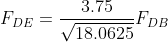
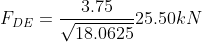
Knowing that Fdb is a compression member, it is automatic that its y-comp goes up. Thus, Fde can be assumed to go down to be in equilibrium. So we can conclude that Fde is a tension member.
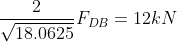


                                   (Compression) 


                                    (Tension)

After joint D, the next joints comprise of more than two members which would make it impossible for us to solve the next member forces. However, joints A and F have two members. So continue the analysis by considering either joint A or joint F.


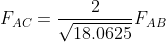
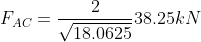
Consider Joint A. Assume directions of force members in joint A. The applied load is vertical, so we can assume the direction of the force with a vertical component first. Fab turns to be in compression to resist the reaction. This compressive assumption directs the x-component of Fab to go to the left. Thus Fac should go to the right.


The procedure on how you assumed the vector directions should be the same procedure in solving the force member magnitudes.
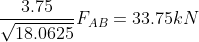


                                      (Compression)


                                                 (Tension)

Consider Joint F. Notice that this joint contain 2 reactions and also 2 perpendicular members. Being perpendicular, these members will not affect each other. So,


                                          (Tension)


                                          (Compression)

Now that most of the members are determined, we can continue solving for the other member forces.


Consider Joint E. With forces surrounding the joint. Assuming the vector direction of the unknown member forces is a little more complicated where sometimes, pure simple assumption will be used. A simple analysis is check the result of the vertical loads. This gives us the idea that Fce should be in compression. Although that hypothesis maybe is certain, Fbe will be purely an assumption. So if the result turns to be positive, the assumption is correct, if not then it is the other direction.



                                           (Compression)


                                                     (Compression) 

Lastly, consider joint B. Although the known loads are inclined, it is easy to detect that the load going downward is less than that going up. So Fbc can be assumed as going down, making the force in tension.



                                             (Tension)


Monday, 11 March 2019

EXAMPLE 7.0.12. FINDING REACTIONS OF INCLINED SUPPORTS

Determine the reactions of the truss with the following applied load.


The hinge at point A carries parallel and perpendicular to the surface reaction components. The roller at C carries one unknown reaction, perpendicular to the surface.

Summation of horizontal forces  does not apply as the first procedure because both supports do have horizontal forces.


                               downwards

By taking the moment about point A, the reaction Rc will be determined. However, since this reaction is inclined, it would be difficult to measure the moment arm, thus we use the components of Rc.


                          inclined upwards

Then we can solve for the horizontal reaction at point A.


                      to the left


RELATED TOPIC:

7.0. EQUILIBRIUM OF FORCE SYSTEMS